Three-Node X-Chain
A Three-Node X-Chain — traditionally listed as 3 Strong Links and called an L(1)-Wing in strmckr's signature system — is the general length-3 same-digit AIC. Its signature is (A=B)-(C=D)-(E=F): three strong-inference nodes joined by two weak inferences. The chain proves the inclusive endpoint relation A OR F.
What is a Three-Node X-Chain?
Write the construction as (A=B)-(C=D)-(E=F). Each equals sign is a strong link (XOR) between exhaustive alternatives; each dash is a weak inference (NAND) whose connected sides cannot both be true. All length-3 same-digit chains of link types 0–3 are L(1)-Wings: parallel-line, alternating row-column and grouped forms belong to the same class. Named subclasses such as Dual Empty Rectangle, Rec't Kite and Bridged Empty Rectangle require specific ERi-link sequences; the house arrangement alone does not establish those names.
Walkthrough example
A walkthrough of one Three-Node X-Chain written as (A=B)-(C=D)-(E=F), proving the inclusive endpoint relation A OR F.
Step 1
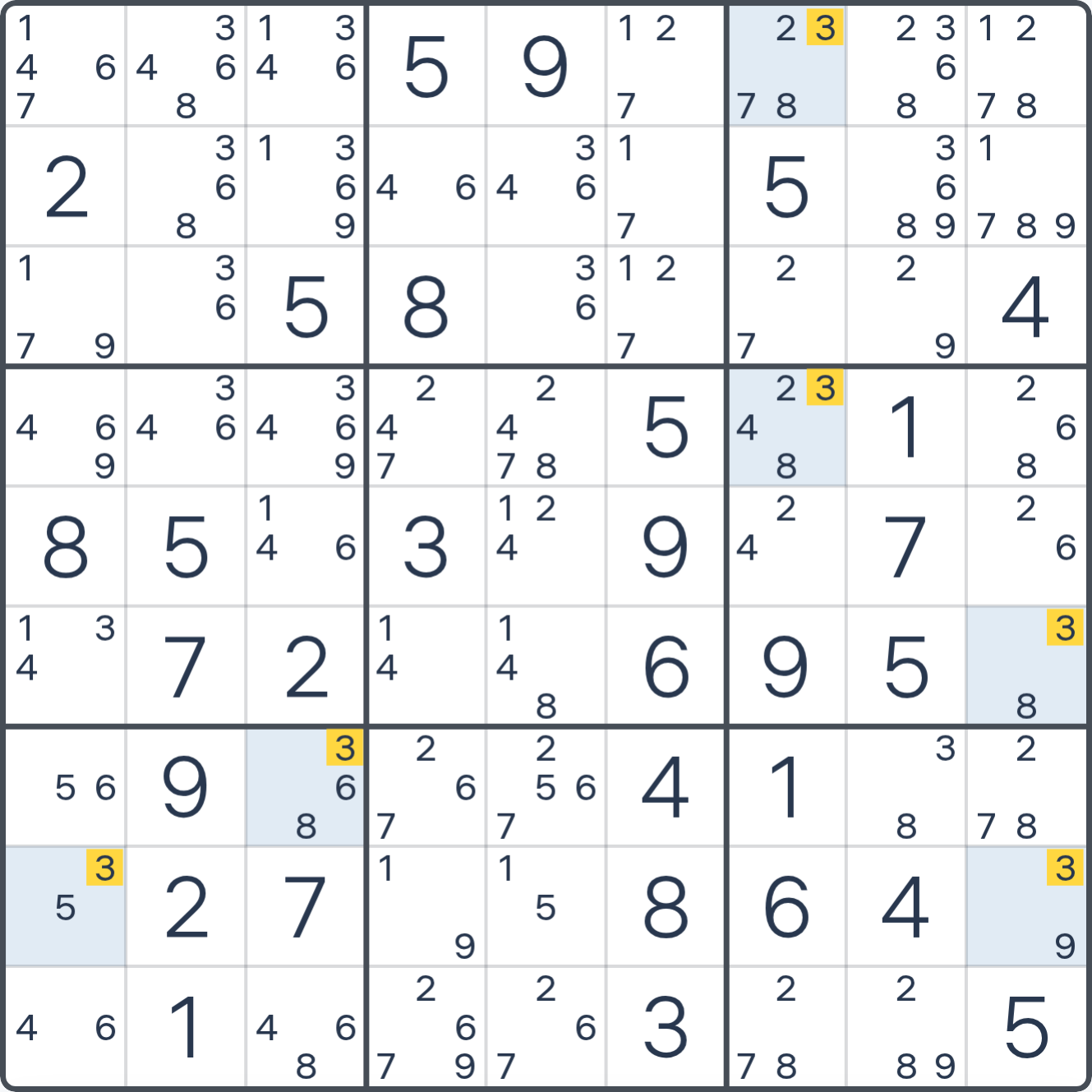
Consider these 6 cells.
Step 2
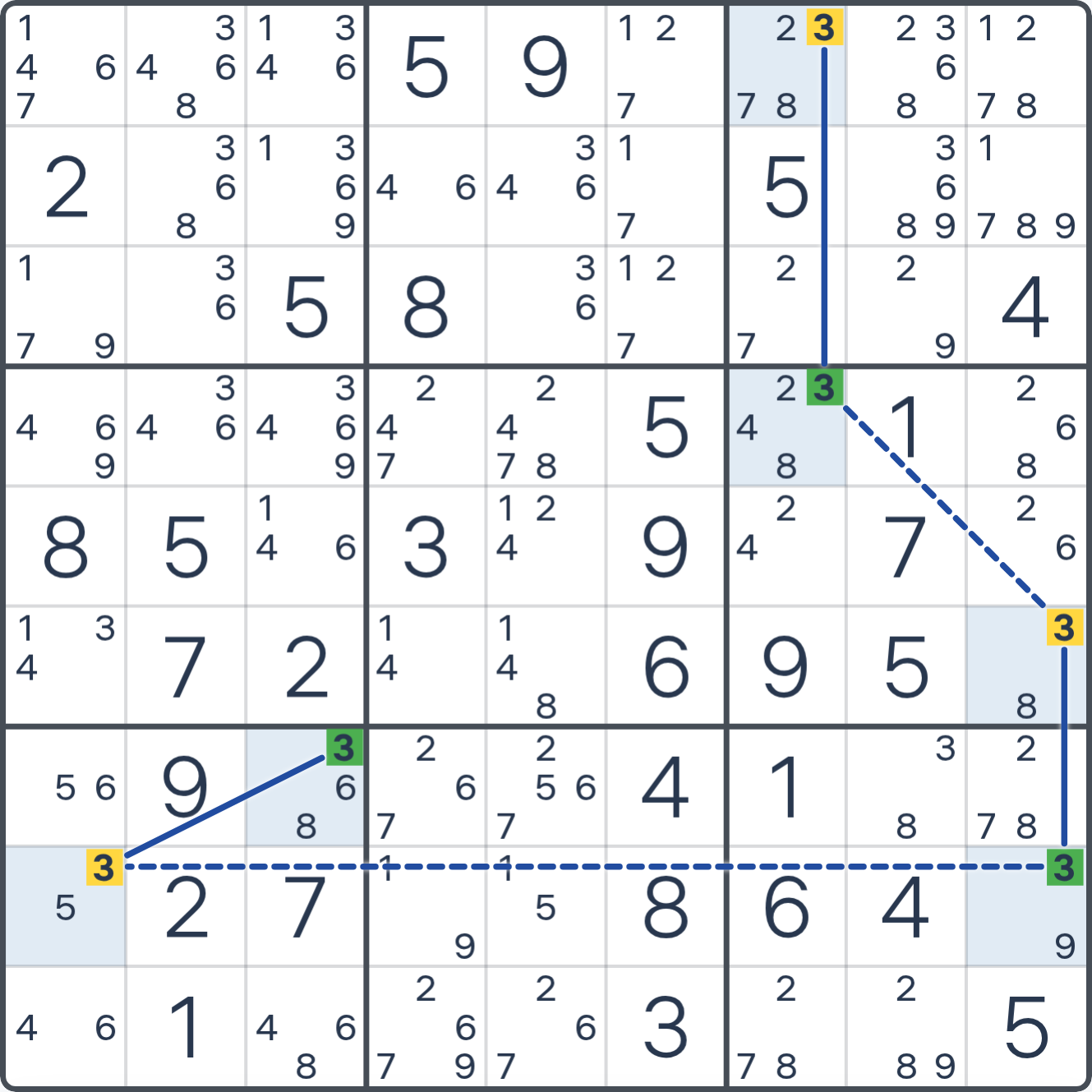
Write the three-node X-Chain for 3 as (G1=G4)-(I6=I8)-(A8=C7). The three equals signs are strong links (XOR nodes) in column 7, column 9 and block 7; the two dashes are the weak inferences (NAND constraints) G4-I6 and I8-A8 in block 6 and row 8. If G1 is false, the alternating inferences make G4 true, I6 false, I8 true, A8 false, and C7 true. Therefore the endpoints satisfy G1 OR C7: at least one contains 3, possibly both.
Step 3
This is the Type 1 same-digit elimination: because G1 OR C7 is proved for 3, remove 3 from every candidate that sees both endpoints.
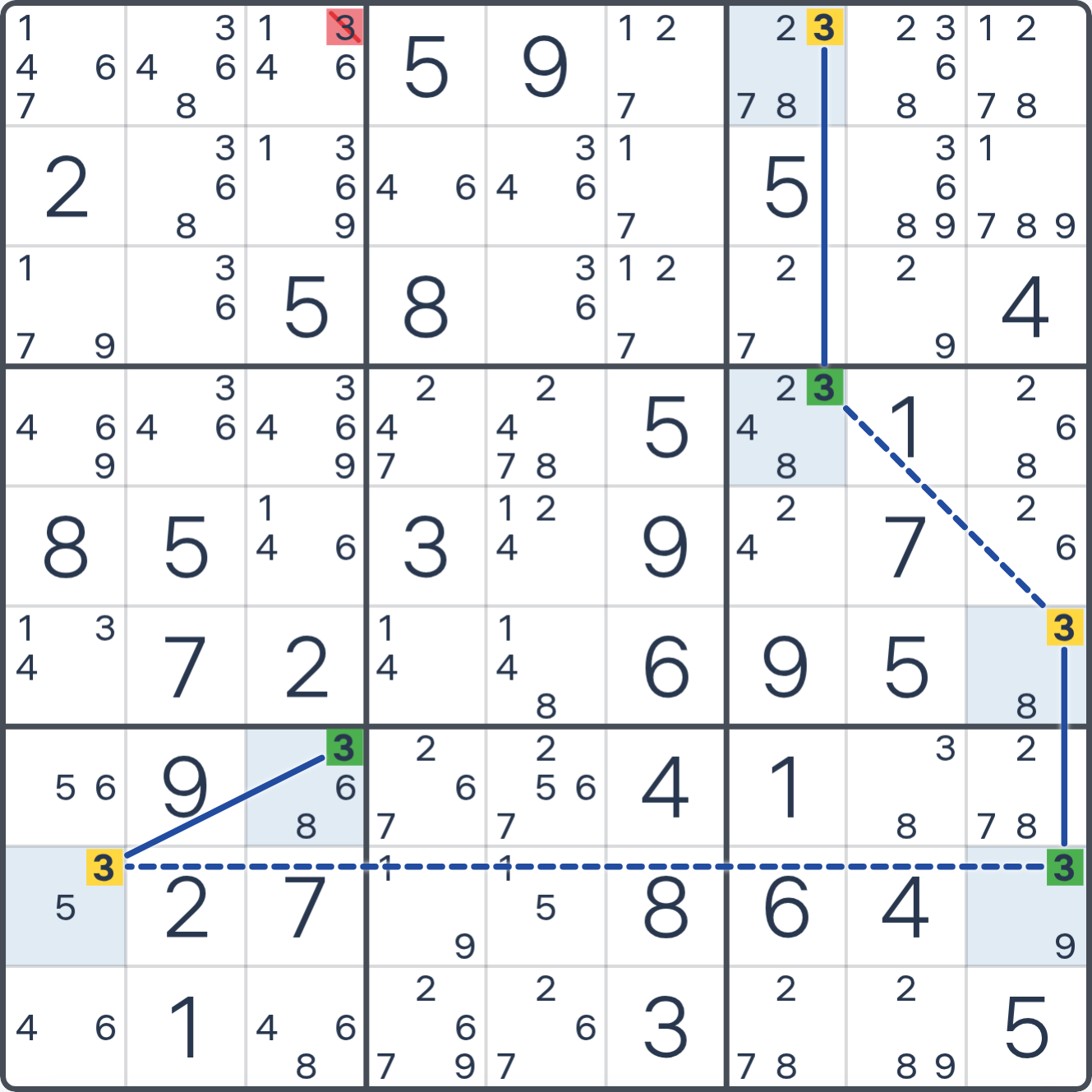
The general signature (A=B)-(C=D)-(E=F) supplies three strong links (XOR) and two weak inferences (NAND), proving A OR F without selecting one unique internal assignment. A common-peer elimination follows from that endpoint relation. This is the Type 1 same-digit elimination. You can play Sudoku free online to practise with the current candidate state visible.
How to spot it
For one digit, identify three justified strong-inference nodes and verify the weak inferences B-C and D-E. The candidate propositions and relations define the chain; a familiar drawing does not. The outer sides A and F are the endpoints, and a target must see both.
The logic
If A is false, the alternating inferences make B true, C false, D true, E false, and F true. Therefore A OR F is true, possibly both. Any same-digit candidate seeing both endpoints can be removed. This is the Type 1 same-digit elimination; the theorem does not claim one unique internal assignment for the open chain.