Grouped Three-Node X-Chain
A Grouped Three-Node X-Chain — traditionally listed as Grouped 3 Strong Links — is an L(1)-Wing with grouped alternatives and signature (A=B)-(C=D)-(E=F). At least one logical side represents several same-digit candidates. The three strong inferences and two weak inferences prove the inclusive endpoint relation A OR F.
What is a Grouped Three-Node X-Chain?
A grouped side is a disjunction: it is true when at least one represented candidate is true and false only when all represented candidates are false. Each equals sign is a strong link (XOR) joining two exhaustive logical sides. Each dash is a weak inference (NAND) and requires universal incompatibility between the candidates represented on its connected sides.
Walkthrough example
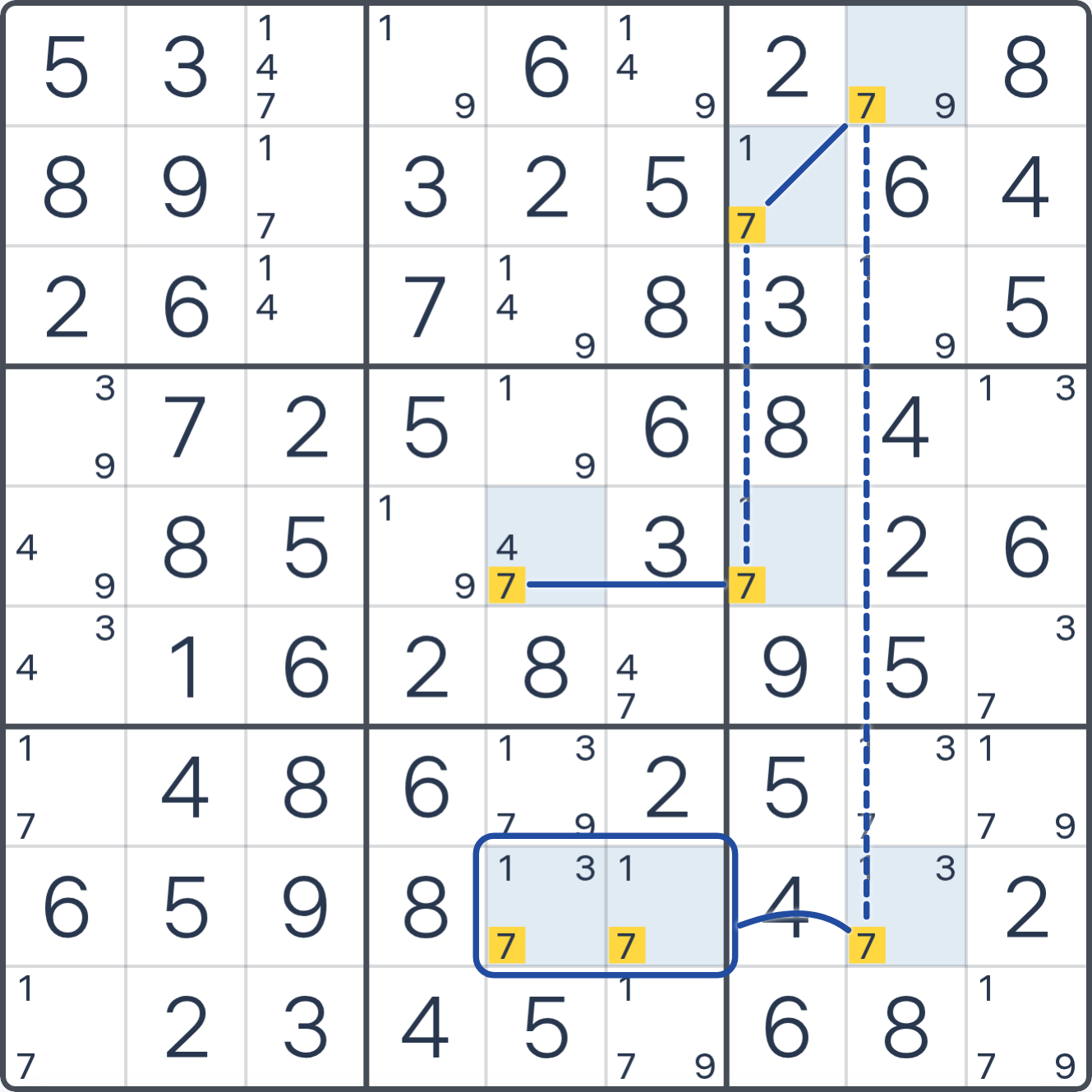
One grouped L(1)-Wing for digit 7: row 5, box 3 and row 8 supply the three strong nodes. In row 8 the candidates are confined to a grouped side of two cells, E8 or F8, outlined by a frame — that side is true when at least one of its members contains 7. Two weak inferences in columns 7 and 8 connect the nodes, proving the endpoints E5 OR (E8 or F8): G5 sees E5 and both group members, so it cannot contain 7.
Step 1
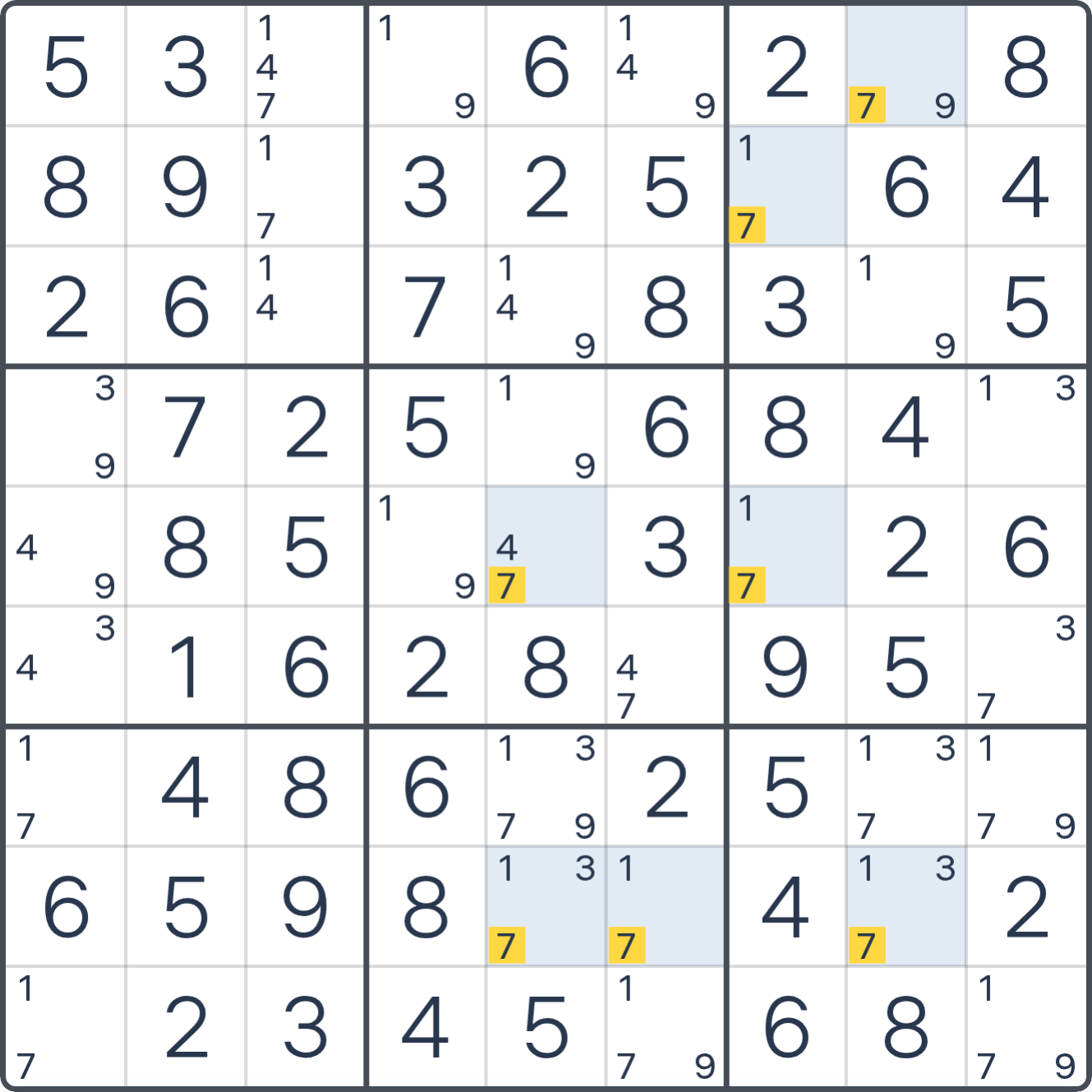
Consider these 7 cells.
Step 2
The highlighted candidates for 7 in row 5, block 3 and row 8 form a grouped three-node X-Chain with the signature (A=B)-(C=D)-(E=F). Each equals sign is a strong link (XOR) between two exhaustive logical sides; a side may be one cell or a group of cells. A grouped side is true when at least one of its members is true and false only when all of its members are false. The two dashes are independently valid weak inferences (NAND constraints) through column 7 and column 8: every candidate represented on one connected side conflicts with every candidate represented on the other. Propagating false-to-true through each strong link and true-to-false through each weak inference proves the endpoint disjunction (E5) OR (E8 and F8). At least one outer logical side contains 7, possibly both.
Step 3
This is the Type 1 same-digit elimination: any red 7 can be removed because it sees every candidate on both outer logical sides: (E5); and (E8 and F8). Their proved inclusive OR means at least one side contains 7, possibly both.
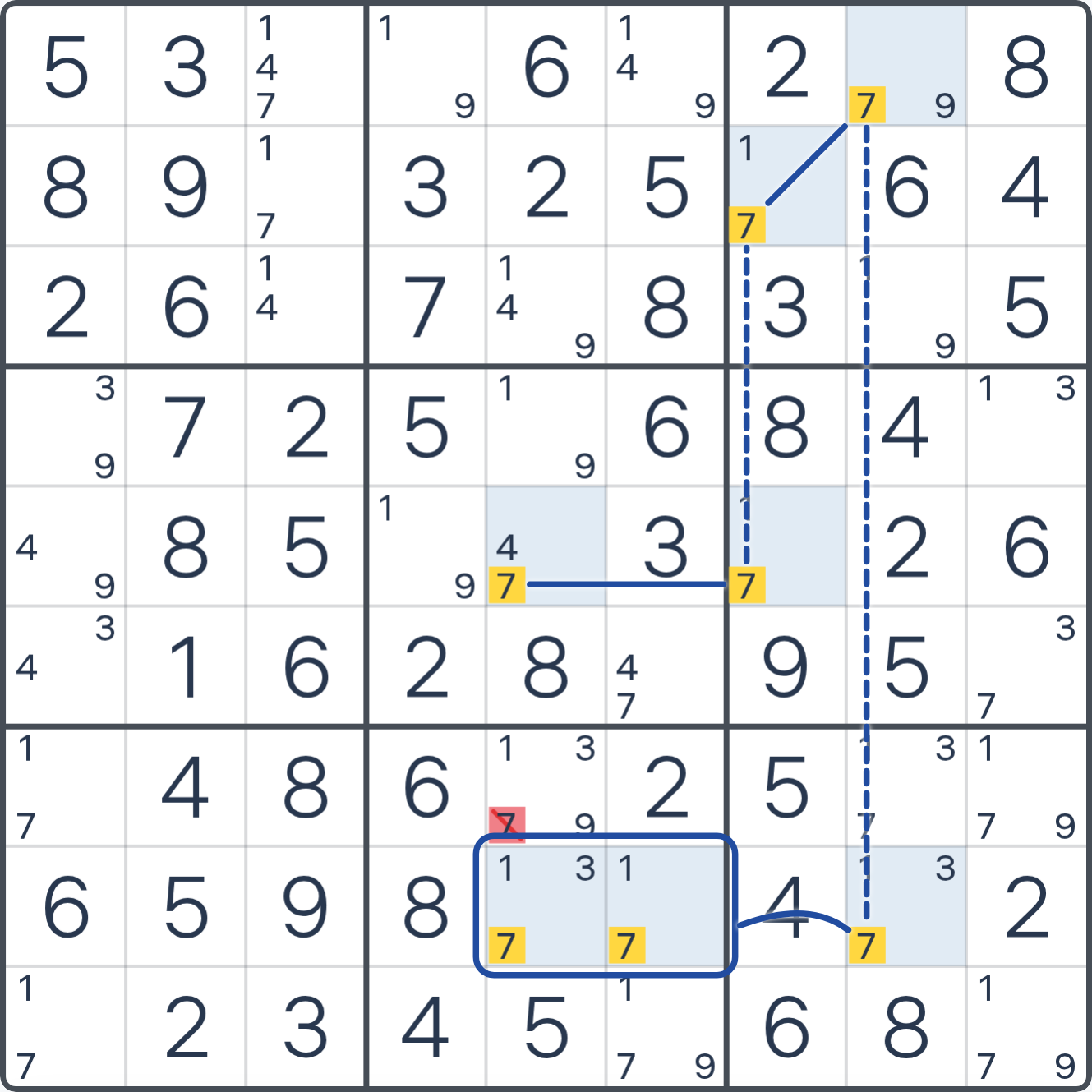
The grouped signature (A=B)-(C=D)-(E=F) proves A OR F when every strong link (XOR) is exhaustive and every weak inference (NAND) is universally valid. A target must conflict with every candidate represented by both endpoint sides. This is the Type 1 same-digit elimination. You can play Sudoku free online to practise with the current candidate state visible.
How to spot it
For one digit, identify three justified strong-inference nodes, allowing row-box or column-box groups, and verify weak inferences B-C and D-E member by member. The outer logical sides A and F are the endpoints. A target is valid only when it conflicts with every candidate represented by both sides.
The logic
Starting with outer side A false propagates true and false states through (A=B)-(C=D)-(E=F) until F is true. Therefore A OR F holds, possibly with both sides true. A target candidate can be removed only if it conflicts with every member of both endpoint sides. This is the Type 1 same-digit elimination.