Three-Node Same-Digit AIC Ring
A Three-Node Same-Digit AIC Ring — the technique traditionally listed as (3 Strong Links) X-Loop — is a continuous ring of three single-digit strong links (XOR) joined and closed by weak inferences (NAND). Because the closing weak inference makes the chain a ring, every weak edge becomes an exact-one pair, justifying eliminations along all three weak links.
What is a Three-Node Same-Digit AIC Ring?
A representative ring is (A=B)-(C=D)-(E=F) closed by a weak inference from the final side back to the first. Each equals sign marks a strong link (XOR) between two exhaustive positions of the digit, and each dash a weak inference (NAND) — not both. The closing weak inference must be verified independently of the path to form a continuous ring.
Walkthrough example
A walkthrough of one Three-Node Same-Digit AIC Ring: three strong links (XOR) closed by a weak inference verified independently of the path.
Step 1
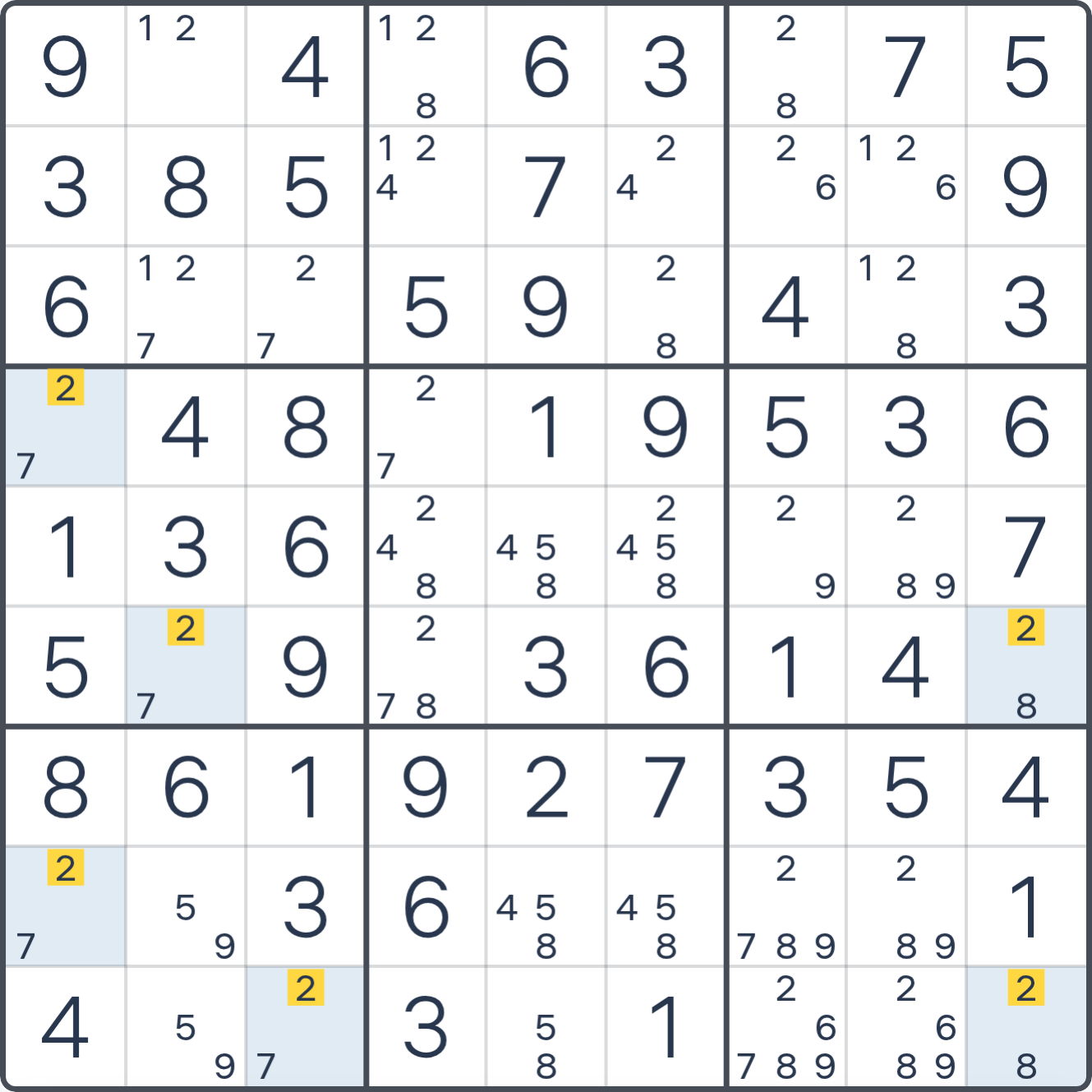
Consider these 6 cells.
Step 2
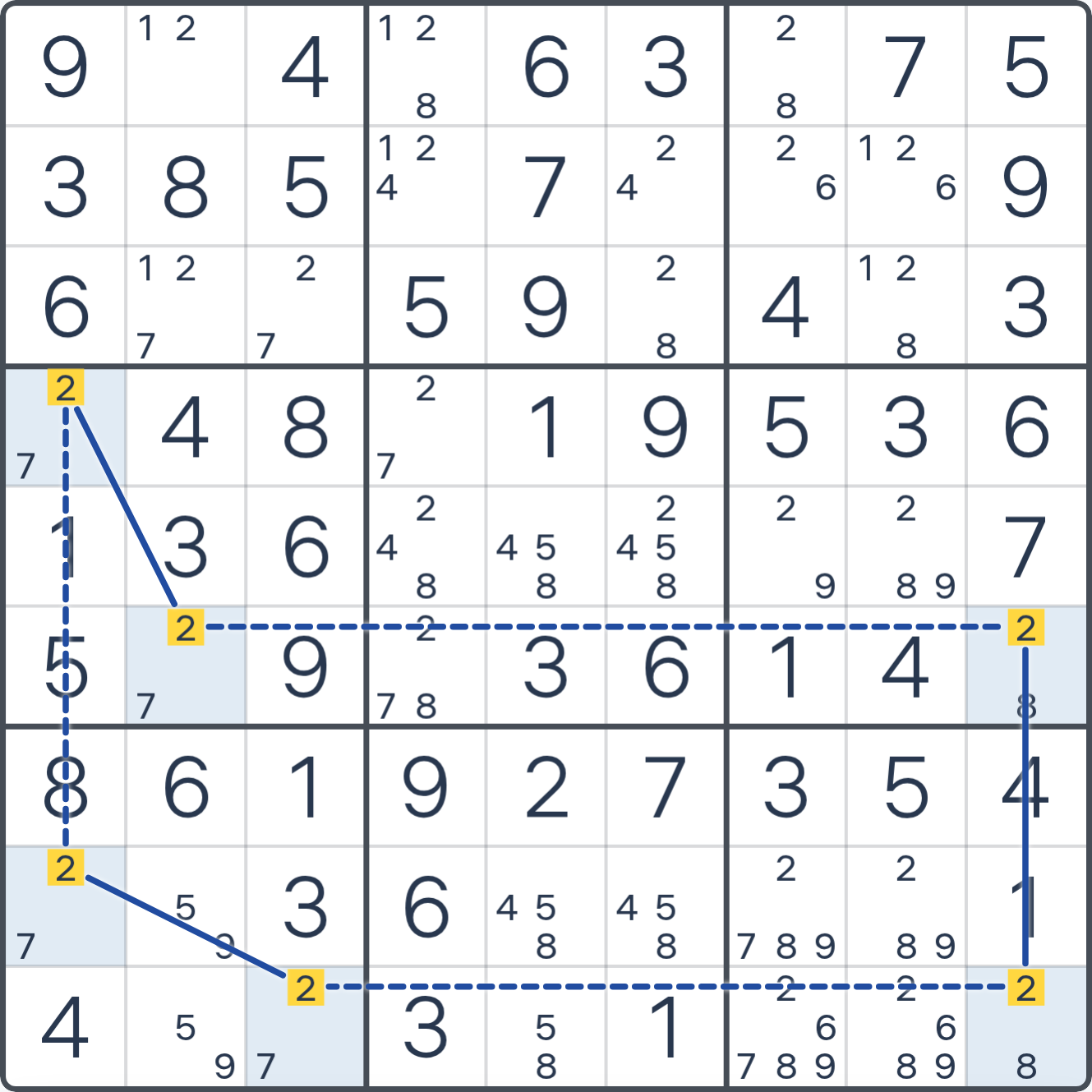
The highlighted candidates for 2 form the closed three-node ring (A4=B6)-(I6=I9)-(C9=A8). Each equals sign is a strong link (XOR) between two logical sides in block 4, column 9 and block 7: exactly one of the two sides contains 2, and a side may be one cell or a group of cells. Each dash is a weak inference (NAND) through row 6, row 9 and column 1: the two linked sides cannot both contain 2. The dash through column 1 is verified independently of the path — it closes the ring, so the endpoint theorem supplies its complementary strong inference and every weak edge of the ring becomes an exact-one pair.
Step 3
Any red 2 can therefore be removed. It lies outside the ring's strong-link houses and sees every highlighted 2 in at least one connecting house (row 6, row 9 and column 1) — that is, both sides of the weak edge there. The closed ring makes that edge exact-one, so one of its ends is always true and excludes the red candidate.
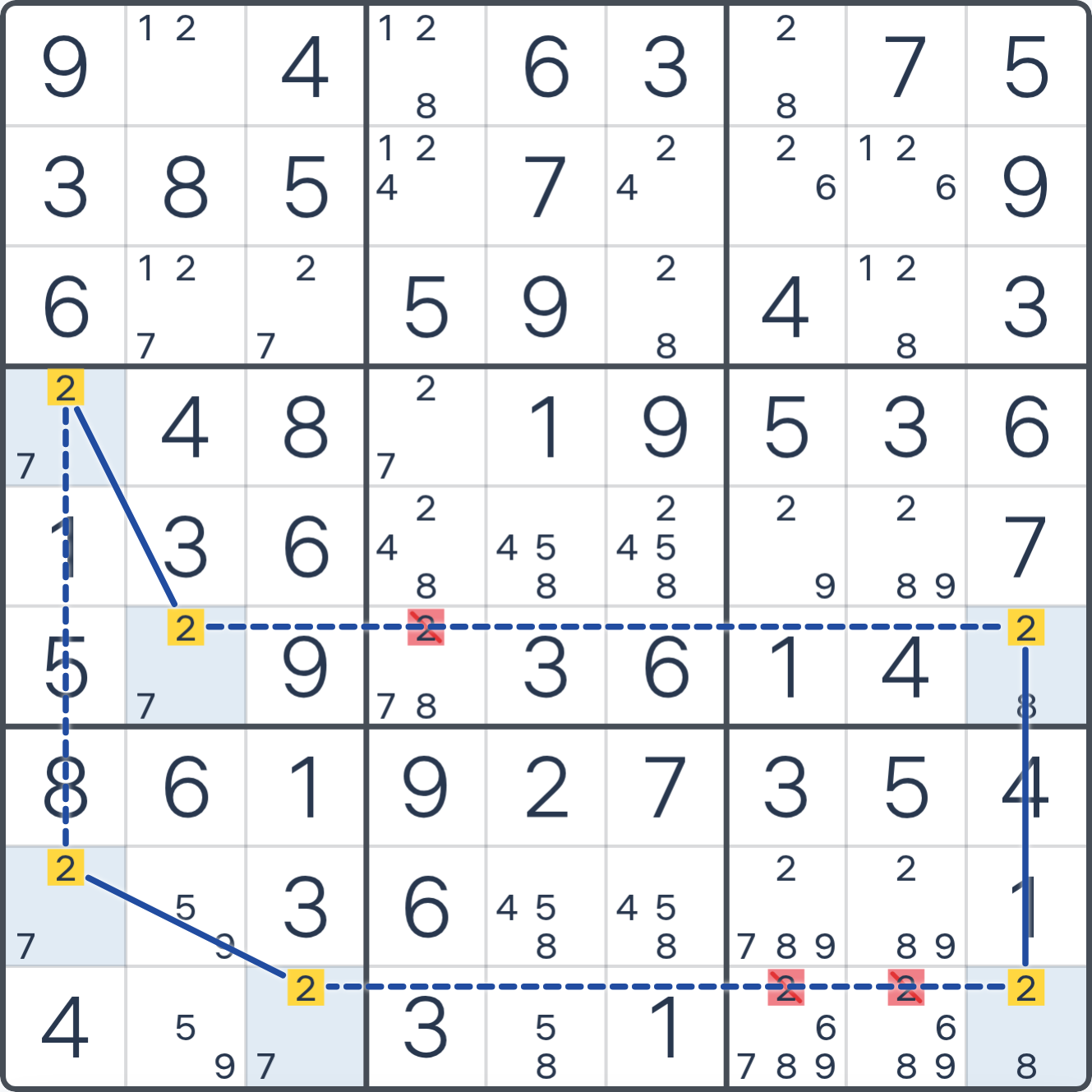
A three-node same-digit ring alternates strong links (XOR) with weak inferences (NAND) and closes through a weak inference verified independently of the path. The endpoint theorem saturates the closing pair, so every weak edge around the ring gains a complementary strong inference, and the digit can be removed from any cell that sees both sides of one of those saturated pairs. You can play Sudoku free online to practise with the current candidate state visible.
How to spot it
Choose one digit, list three strong nodes — each a strong link (XOR) between two positions of the digit — and verify both weak connections. Then verify the closing weak inference; geometric closure is insufficient.
The logic
If A is false, the strong link makes B true, the weak edge makes C false, and the propagation continues: D true, E false, F true. With the closing weak inference verified, the endpoint theorem supplies the missing strong inference between the closing pair, so every weak edge around the ring gains a complementary strong inference — eliminate the digit from any cell that sees both sides of one of those saturated pairs.