Mixed AIC Ring
A Mixed AIC Ring — traditionally listed as Bidirectional Cycle (XY-Cycle) — is a closed AIC that combines bilocation strong links (one digit, two positions) with bivalue strong links (one cell, two digits), closed by a final weak inference verified independently of the path. The candidate propositions and links define the deduction; a count of highlighted cells or a familiar drawing does not.
What is a Mixed AIC Ring?
A bilocation node is a strong link (XOR) between two positions of one digit; a bivalue node is a strong link (XOR) between two digits of one cell. Dashes are weak inferences (NAND) — not both — and the ring requires a final weak inference from the last node back to the first, verified independently of the path.
Walkthrough example
A walkthrough of one Mixed AIC Ring: bilocation and bivalue strong links combined in one closed alternating structure.
Step 1
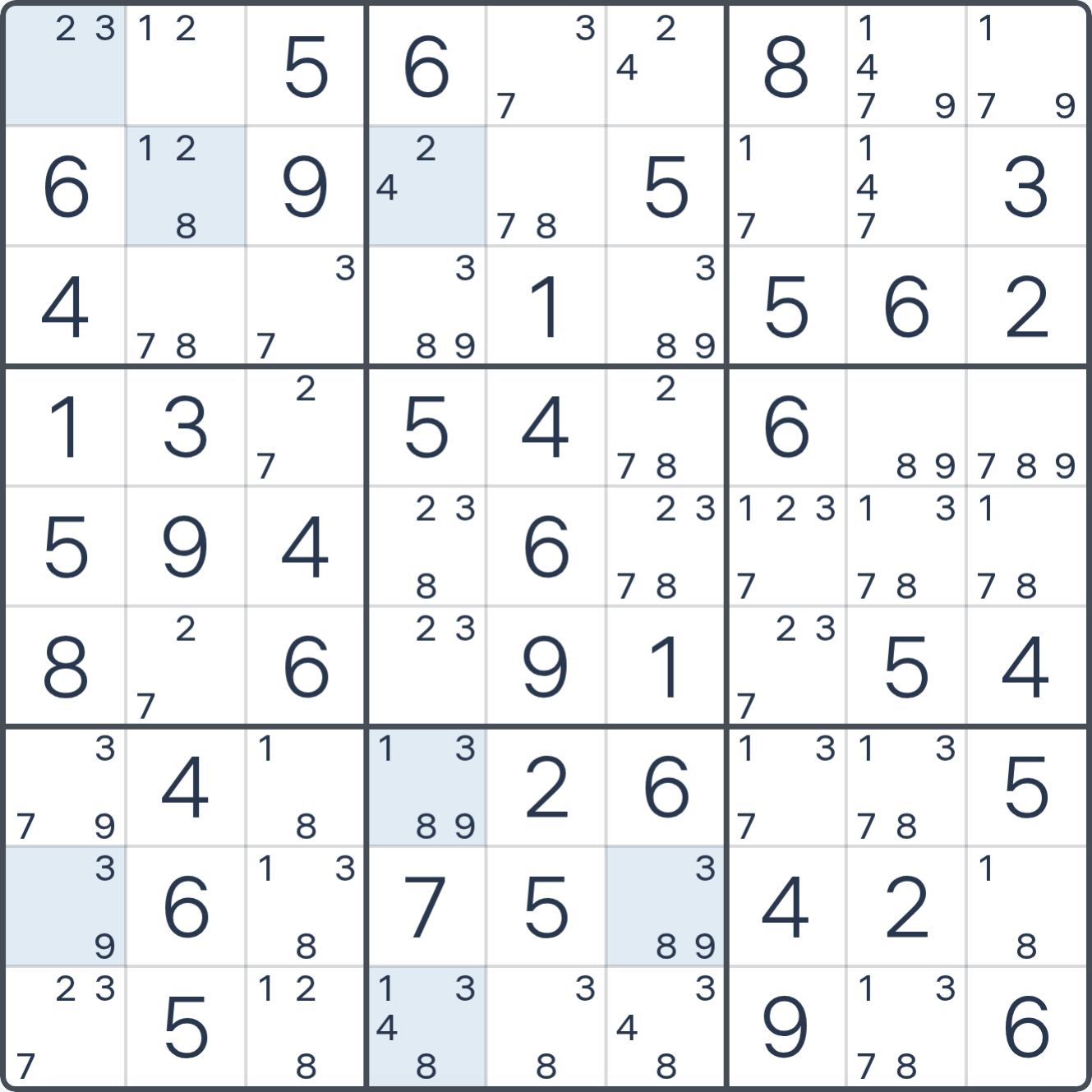
Consider these cells.
Step 2
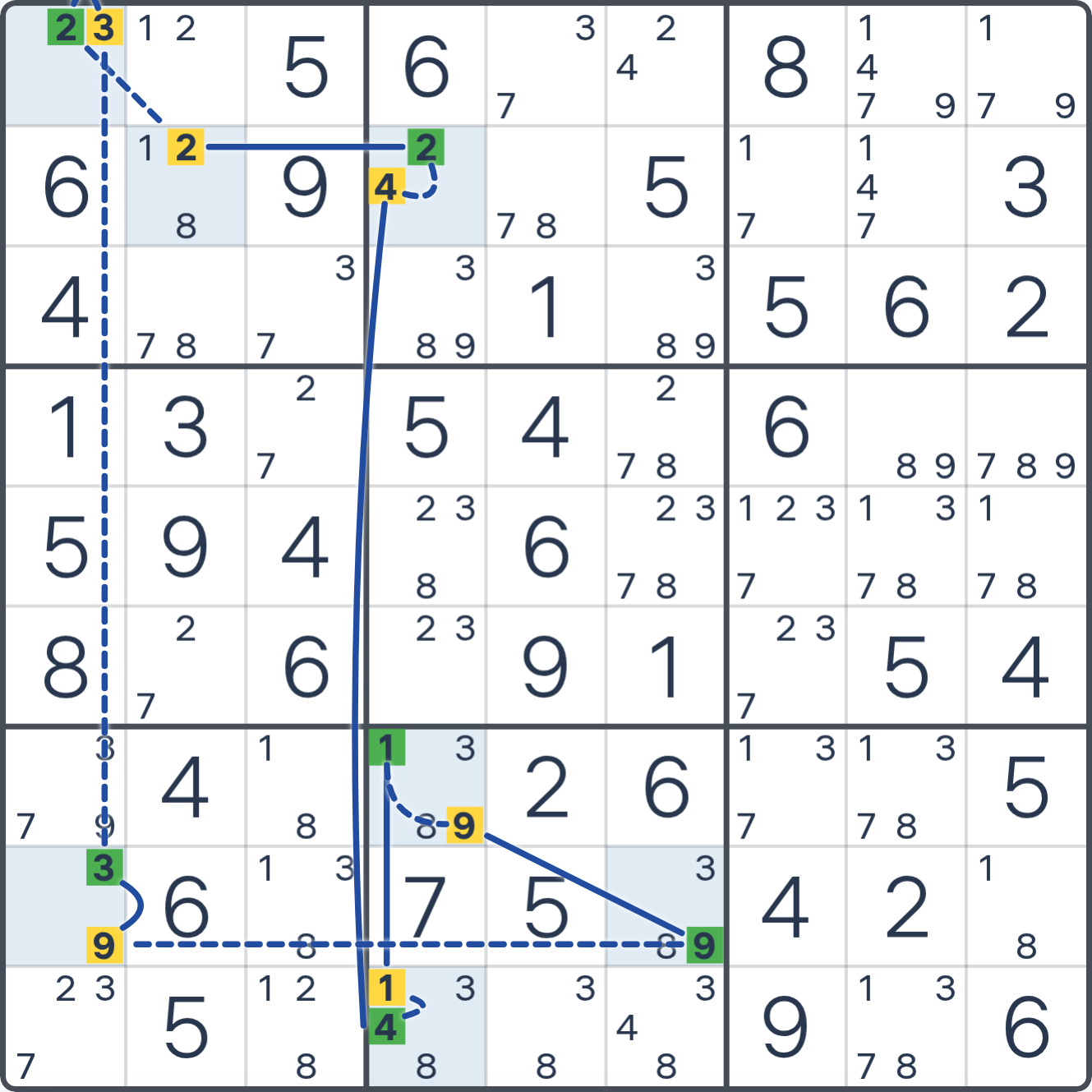
The highlighted candidates form the closed Mixed AIC Ring (B2=D2)-(D2=D9)-(D9=D7)-(D7=F8)-(A8:9=3)-(A1:3=2). Each equals sign is a strong link (XOR); each dash is a weak inference (NAND). The last link, A1=2 back to B2=2, is a weak inference that holds independently of the path — it closes the loop, and the endpoint theorem supplies its complementary strong inference, so every weak edge of the ring becomes an exact-one pair. The numbered implication trace walks the ring in one direction to display the alternating links; it illustrates the closed structure and is not an extra forcing assumption. 1. If A1 contains the value 2, then B2 cannot contain the value 2 (the value can occur only once in the block) 2. If B2 does not contain the value 2, then D2 must contain the value 2 (only remaining possible position in the row) 3. If D2 contains the value 2, then D2 cannot contain the value 4 (the cell can contain only one value) 4. If D2 does not contain the value 4, then D9 must contain the value 4 (only remaining possible position in the column) 5. If D9 contains the value 4, then D9 cannot contain the value 1 (the cell can contain only one value) 6. If D9 does not contain the value 1, then D7 must contain the value 1 (only remaining possible position in the block) 7. If D7 contains the value 1, then D7 cannot contain the value 9 (the cell can contain only one value) 8. If D7 does not contain the value 9, then F8 must contain the value 9 (only remaining possible position in the block) 9. If F8 contains the value 9, then A8 cannot contain the value 9 (the value can occur only once in the row) 10. If A8 does not contain the value 9, then A8 must contain the value 3 (only remaining possible value in the cell) 11. If A8 contains the value 3, then A1 cannot contain the value 3 (the value can occur only once in the column) 12. If A1 does not contain the value 3, then A1 must contain the value 2 (only remaining possible value in the cell)
Step 3
So values 2 and 3 can be removed: closure turns every weak edge of the ring into an exact-one pair, so exactly one of its two alternating assignments holds — and each red candidate conflicts with a true ring proposition in both.
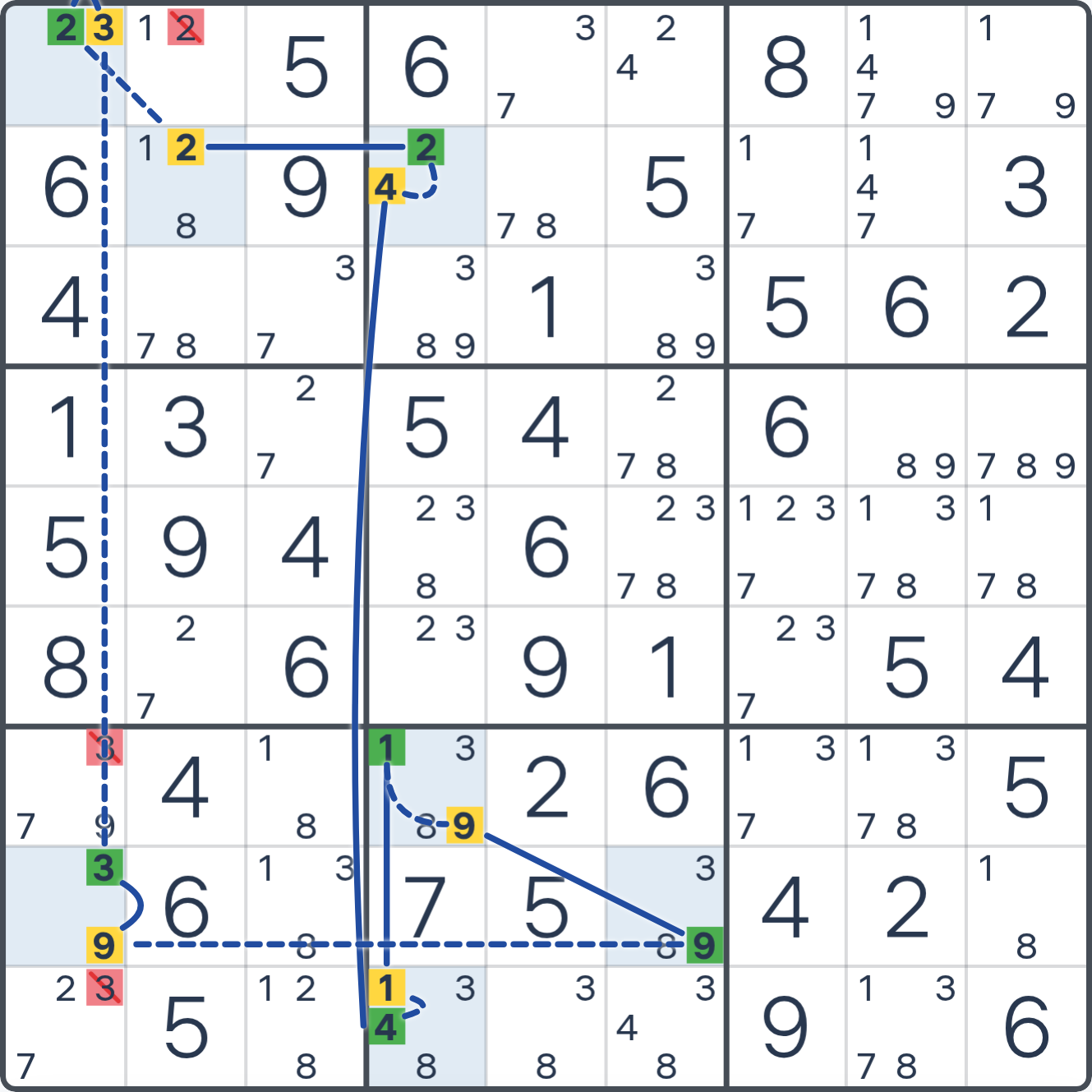
A mixed ring combines bilocation strong links (one digit, two positions) with bivalue strong links (one cell, two digits) and closes through a weak inference (NAND) verified independently of the path. The endpoint theorem saturates the closing pair, so candidates that conflict with both sides of any weak edge can be removed. You can play sudoku online to practise with the current candidate state visible.
How to spot it
Trace the node sequence and classify every strong link — the same digit in two peer cells, or two digits in one cell. Verify each weak connection against the current candidate state, including the closing one; geometric closure alone proves nothing.
The logic
With the closing weak inference verified, the endpoint theorem supplies the missing strong inference between the closing pair, so every weak edge around the ring gains a complementary strong inference. Remove candidates that conflict with both sides of any weak edge; the ring itself never selects which alternating assignment is the solution.