Grouped Three-Node Same-Digit AIC Ring
A Grouped Three-Node Same-Digit AIC Ring — traditionally listed as (3 Strong Links) Grouped X-Loop — is a continuous three-node ring for one digit in which at least one strong-link side is a grouped candidate set inside a box/line intersection. The closing weak inference turns every weak edge of the ring into an exact-one pair.
What is a Grouped Three-Node Same-Digit AIC Ring?
A grouped node must name every candidate occurrence represented on each side. Its strong relation establishes that at least one side is true; a weak inference to another node is valid only when every occurrence that could make the first group true is incompatible with the connected proposition.
Walkthrough example
A walkthrough of one Grouped Three-Node Same-Digit AIC Ring: grouped same-digit strong nodes closed by a weak inference verified independently of the path.
Step 1
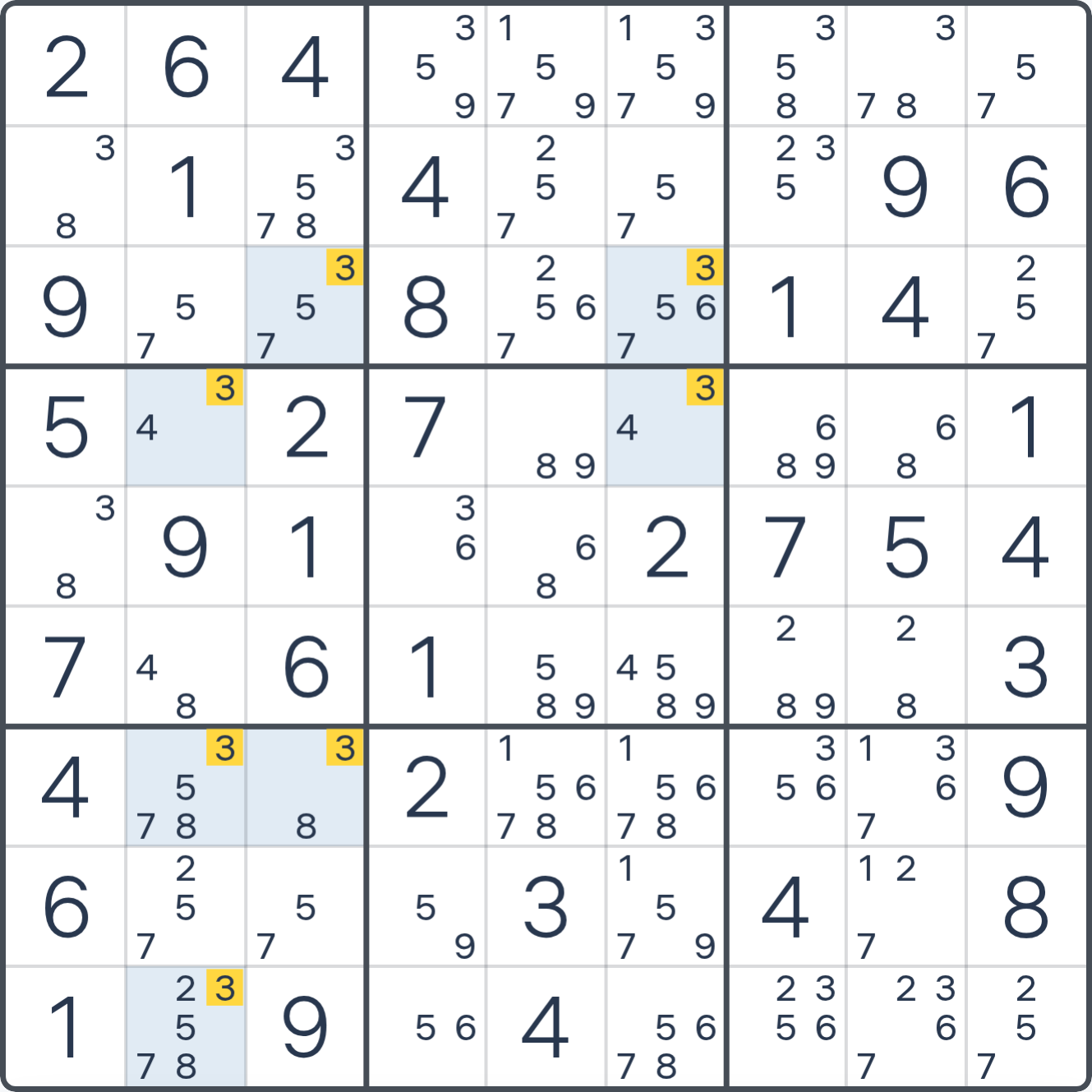
Consider these 7 cells.
Step 2
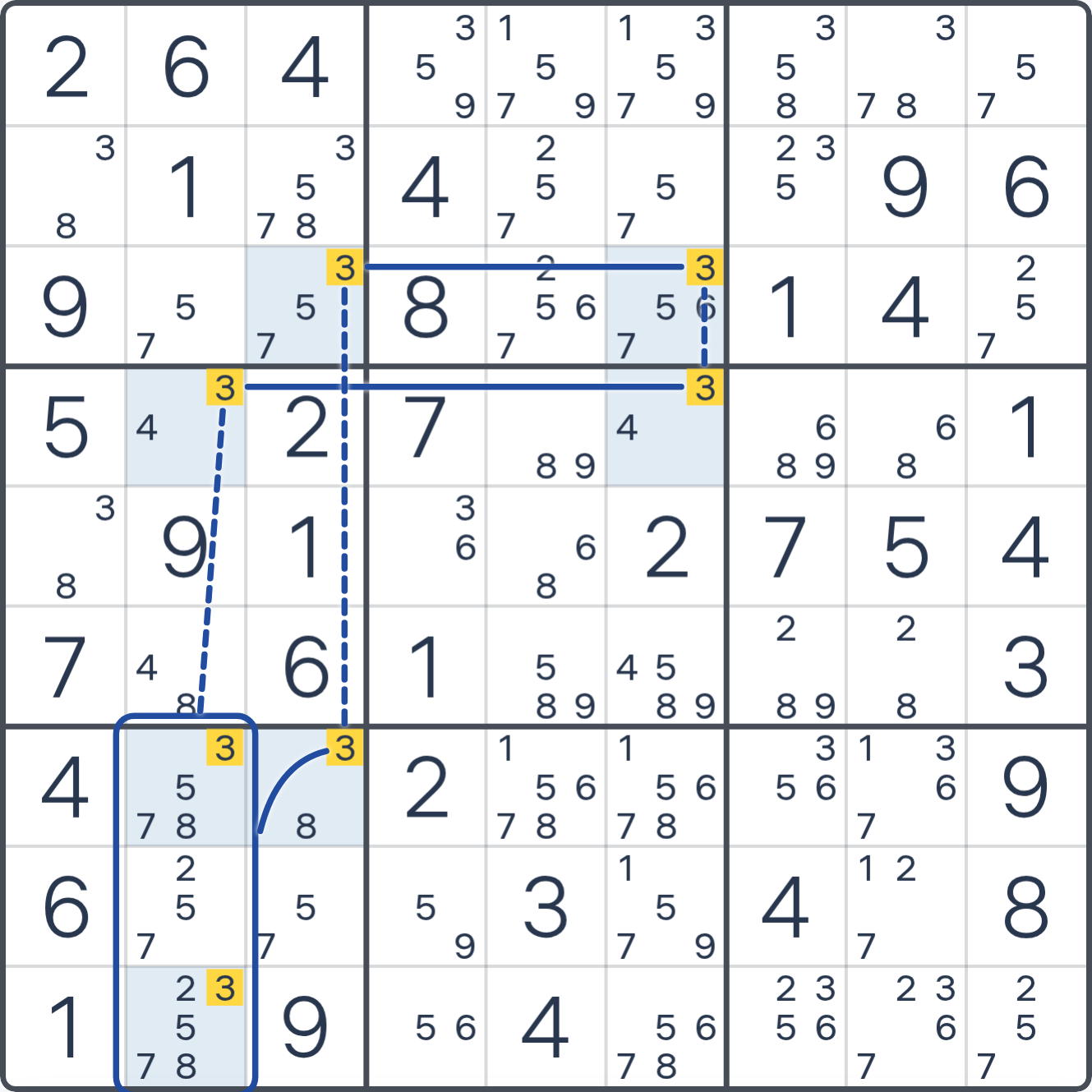
The highlighted candidates for 3 form the closed three-node ring (C7=B9 and B7)-(B4=F4)-(F3=C3). Each equals sign is a strong link (XOR) between two logical sides in block 7, row 4 and row 3: exactly one of the two sides contains 3, and a side may be one cell or a group of cells. When a side is grouped, a converging fan of arrows joins every candidate on the grouped side to the other logical side — the whole fan is one grouped strong link, and no individual arrow forces a particular member. Each dash is a weak inference (NAND) through column 2, column 6 and column 3: the two linked sides cannot both contain 3. The dash through column 3 is verified independently of the path — it closes the ring, so the endpoint theorem supplies its complementary strong inference and every weak edge of the ring becomes an exact-one pair.
Step 3
Any red 3 can therefore be removed. It lies outside the ring's strong-link houses and sees every highlighted 3 in at least one connecting house (column 2, column 6 and column 3) — that is, both sides of the weak edge there. The closed ring makes that edge exact-one, so one of its ends is always true and excludes the red candidate.
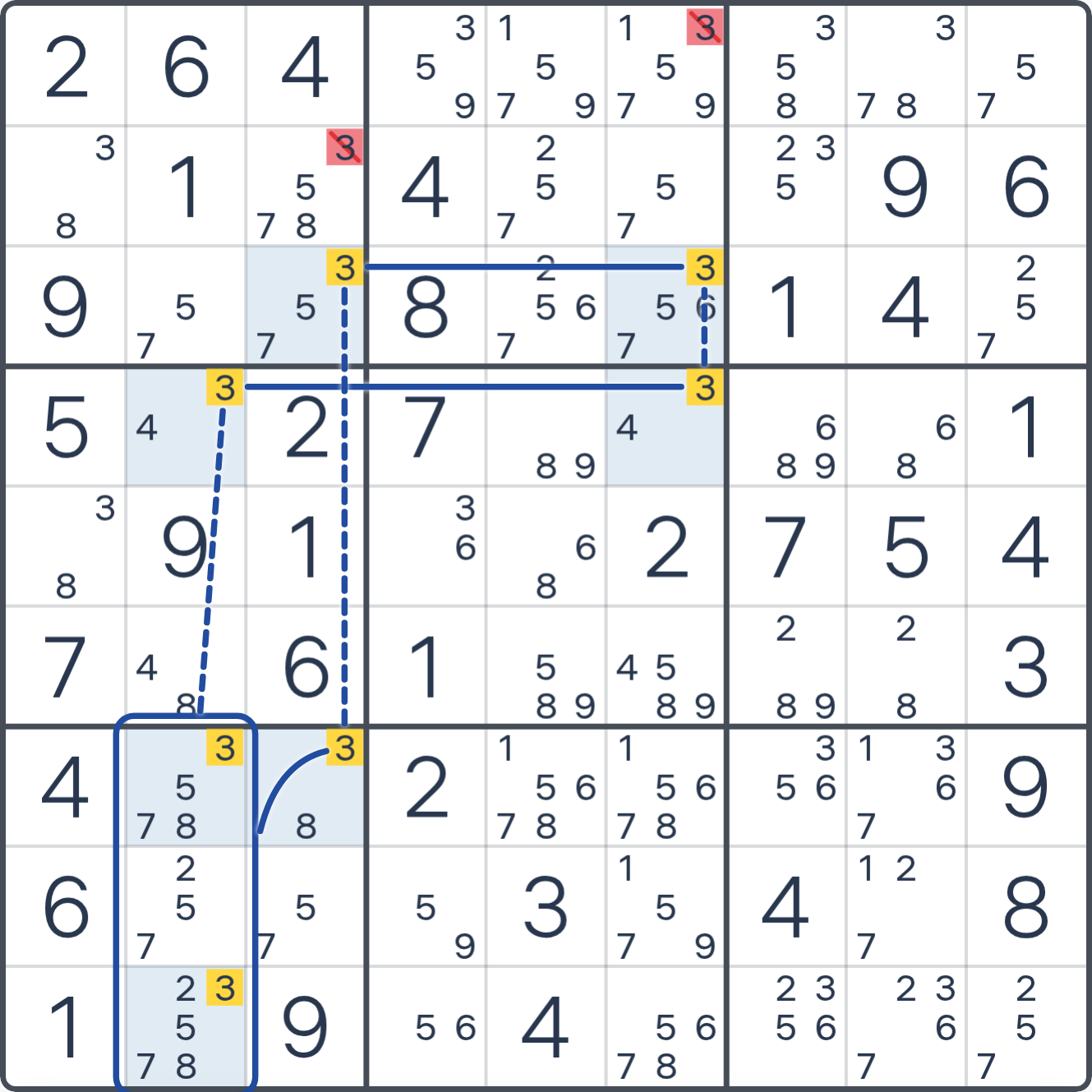
A grouped same-digit ring requires universal incompatibility at every weak edge: a grouped side is false only when all of its represented occurrences are false. Once the closing weak inference is verified, the endpoint theorem saturates the closing pair, and a target is valid only when it conflicts with every candidate represented by both connected sides. You can play Sudoku free online to practise with the current candidate state visible.
How to spot it
For one digit, identify the candidate groups left by row-box or column-box intersections, or by the stated house restriction. Draw the complete node sequence and test every group member at each weak connection. Cell count or visual shape alone does not establish the ring.
The logic
Propagate false through a strong inference to make the other side true, and true through a weak inference to make the connected proposition false. Never infer that a group is false merely because not all of its members can be true. Apply an endpoint or ring conclusion only after the complete sequence or closure is proved.