Nishio
Nishio — the Nishio Forcing Chain — starts from one candidate placement assumption and follows only forced consequences. If the assumption creates a contradiction, that assumption is false.
What is a Nishio Forcing Chain?
A true candidate makes every weakly linked candidate false. A false candidate makes the other side of a strong inference true. False on one side of a weak inference alone proves nothing. A branch choice that is not forced cannot be treated as a consequence. The final contradiction must occur in the state created by the original assumption.
Walkthrough example
A walkthrough of one Nishio: a single candidate assumption is followed to a contradiction, so the assumption is retracted.
Step 1
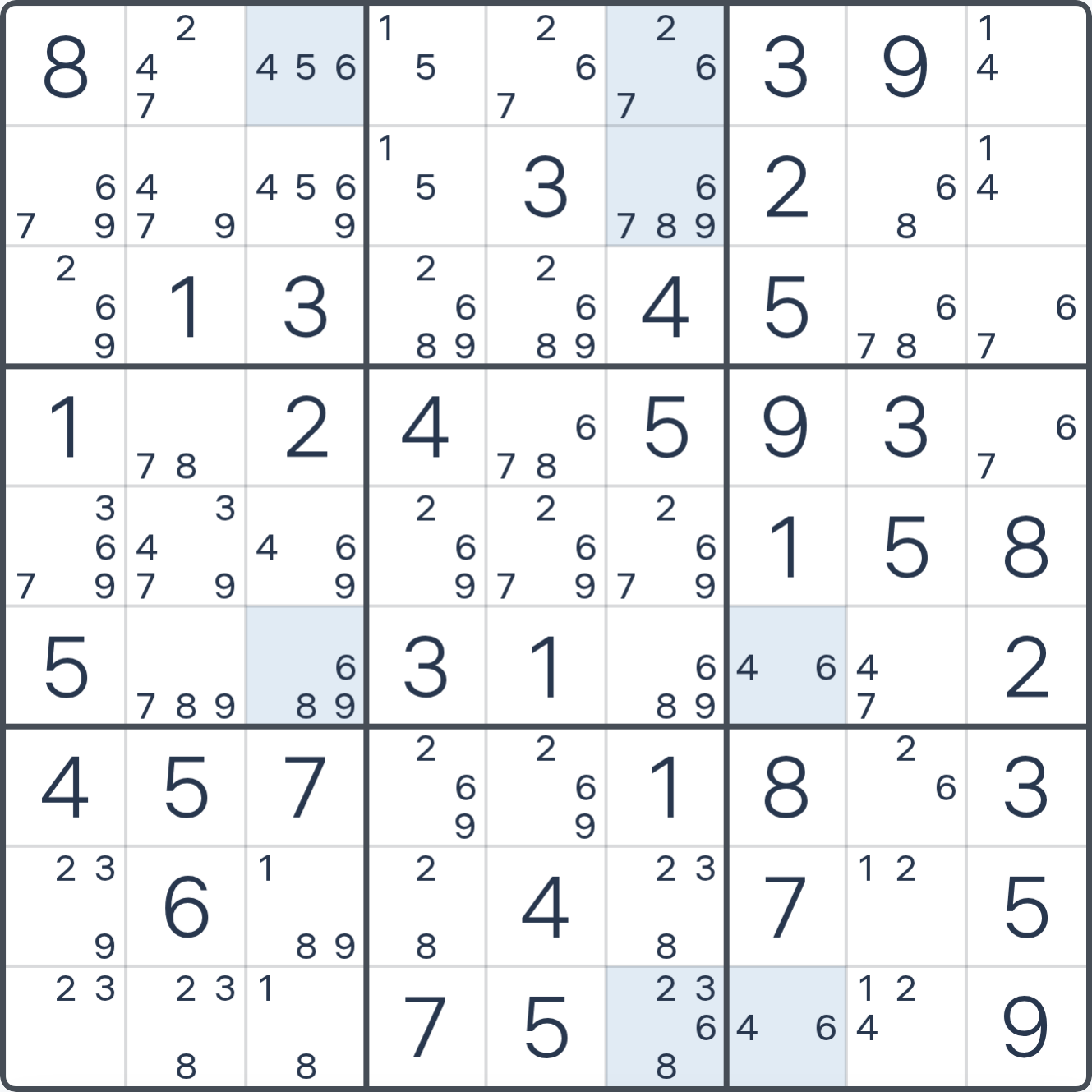
Consider these cells.
Step 2
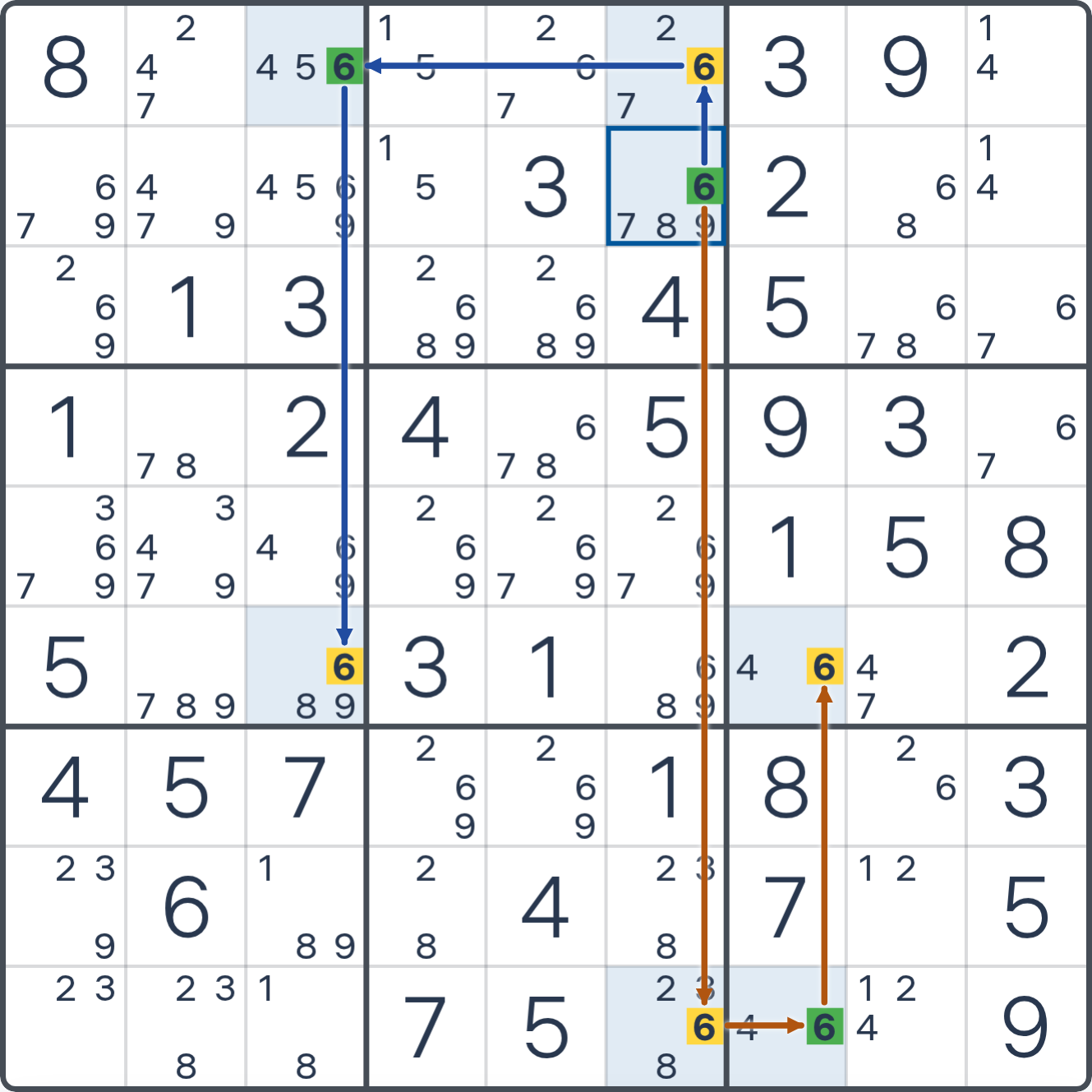
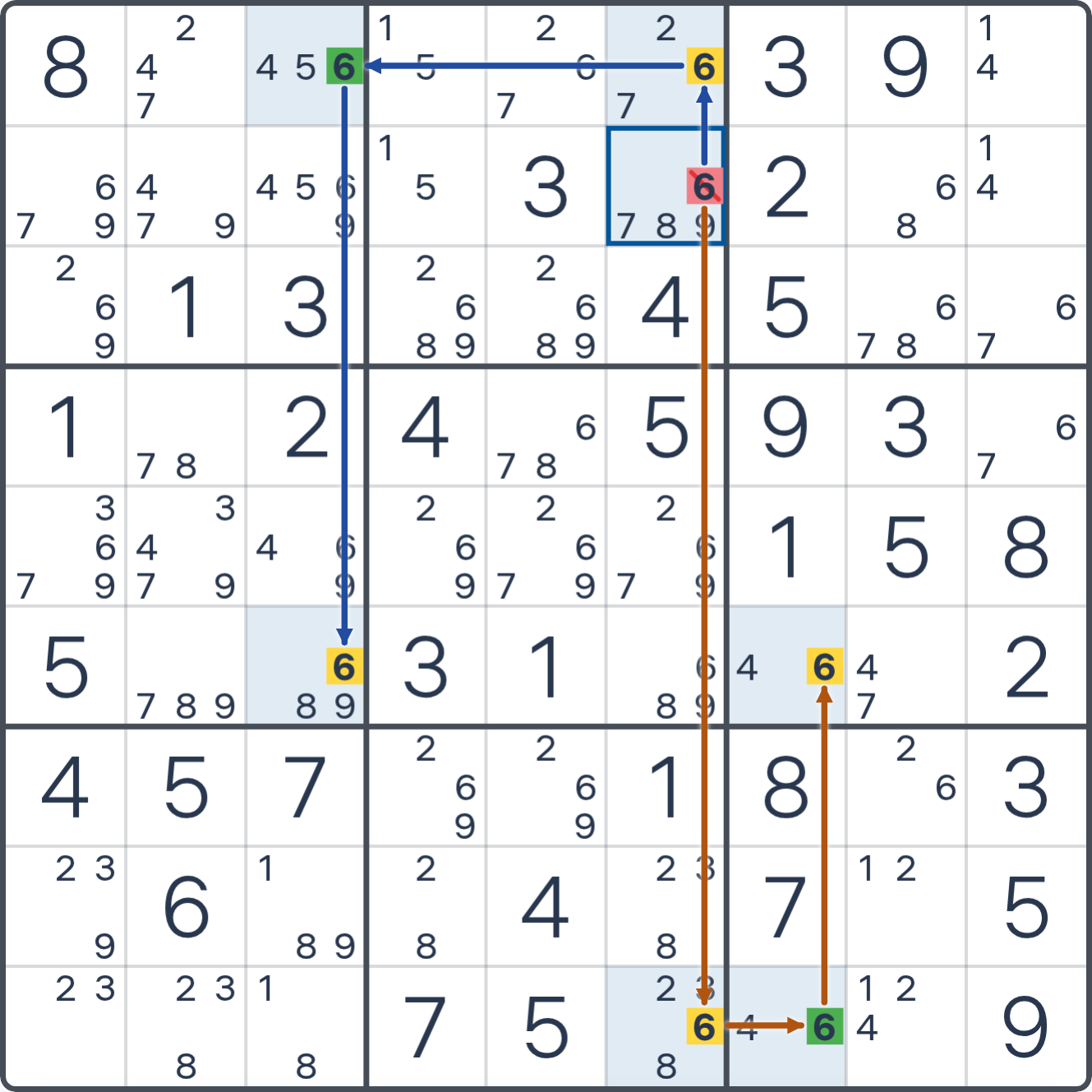
With this solving technique, we will prove that the assumption "F2 must contain the value 6" is false. From this single assumption, two parallel Nishio chains eliminate the candidates for the value 6 in row 6: 1. Chain 1 eliminates C6. 2. Chain 2 eliminates G6. Since C6 and G6 are the only possible positions for the value 6 in row 6, eliminating all of them would leave row 6 with no place for the value 6 — a contradiction. Therefore F2 cannot contain the value 6. The chains are Nishio chains: they only involve a single value (like X-Chains), and the conclusions of the two sub-chains must be combined to reach the contradiction. Chain 1 (eliminates C6): 1. If F2 contains the value 6, then F1 cannot contain the value 6 (the value can occur only once in the block) 2. If F1 does not contain the value 6, then C1 must contain the value 6 (only remaining possible position in the row) 3. If C1 contains the value 6, then C6 cannot contain the value 6 (the value can occur only once in the column). Chain 2 (eliminates G6): 1. If F2 contains the value 6, then F9 cannot contain the value 6 (the value can occur only once in the column) 2. If F9 does not contain the value 6, then G9 must contain the value 6 (only remaining possible position in the row) 3. If G9 contains the value 6, then G6 cannot contain the value 6 (the value can occur only once in the column).
Step 3
So 6 can be removed from F2: assuming F2 contains 6 leads to a contradiction — two parallel chains eliminate every candidate for the value 6 in row 6, leaving row 6 with no place for it. The assumption must be false, so F2 cannot contain the value 6.
This walkthrough shows one valid example of the defined deduction. Confirm the stated source set or assumption, that every branch was tested, and that the applied conclusion is shared by all of them before using the same deduction on another grid. You can play sudoku online to practise with the current candidate state visible.
How to spot it
State the source proposition or exhaustive source set, then annotate every step with its reason. Continue until the assumption forces an empty cell, a digit with no house position, or both a proposition and its negation.
The logic
If assumption A implies a contradiction, A is false; if assumption not-A implies a contradiction, A is true. Optional branches must remain alternatives rather than being reported as forced links.