Cell Forcing Net
A Cell Forcing Net — the technique traditionally listed as Cell Forcing Chain — starts from every candidate in one selected cell and follows only forced consequences. Because the source alternatives are exhaustive, a conclusion reached by every branch is unconditional.
What is a Cell Forcing Net?
A true candidate makes every weakly linked candidate false. A false candidate makes the other side of a strong inference true. False on one side of a weak inference alone proves nothing. A branch choice that is not forced cannot be treated as a consequence. Every remaining source alternative must be tested; one failed branch does not settle the source.
Walkthrough example
A walkthrough of one Cell Forcing Net: every candidate of the source cell is tried as a branch, and only a conclusion shared by all branches is applied.
Step 1
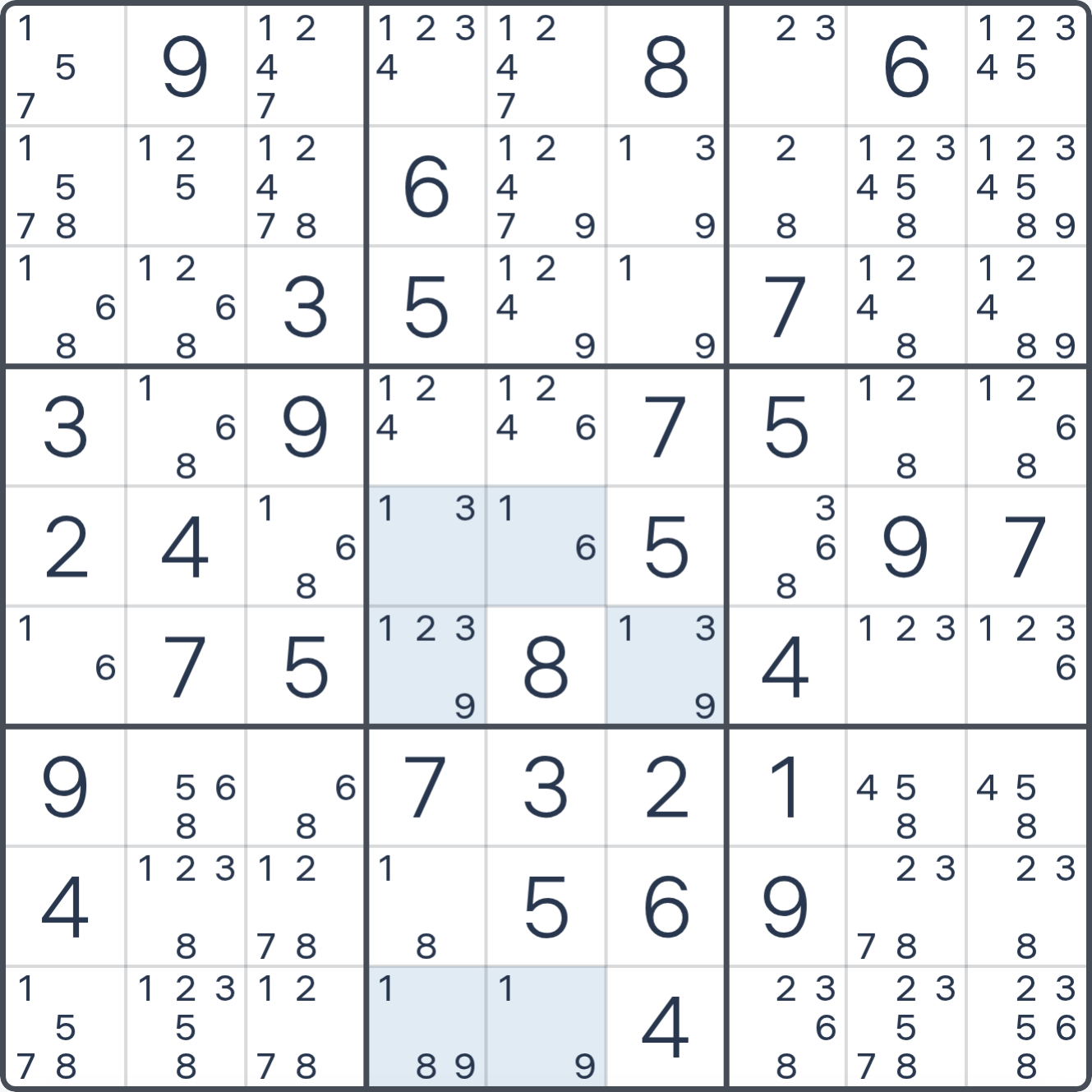
Consider these cells.
Step 2
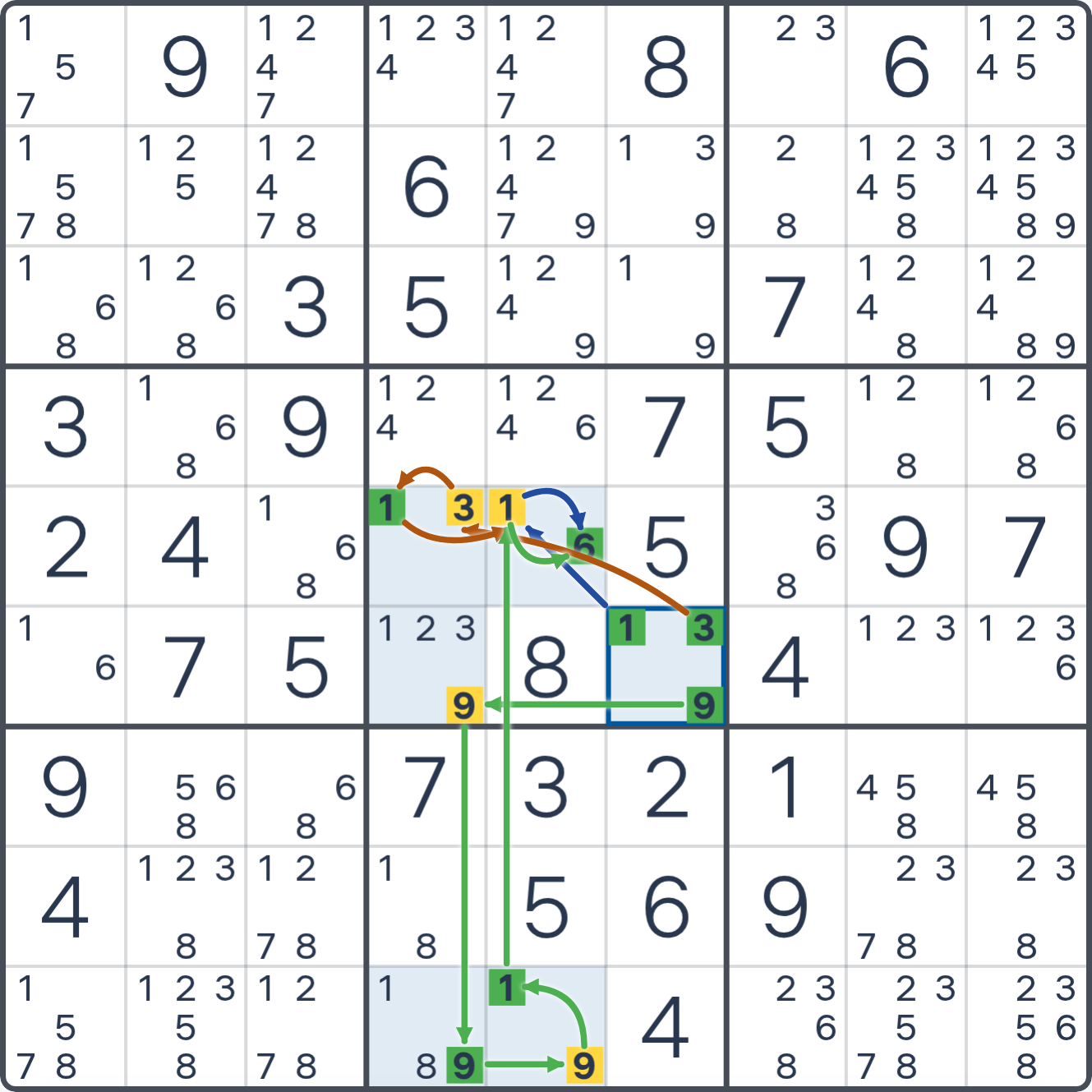
With this solving technique, we will prove the following assertions: 1. If F6 contains the value 1, then E5 must contain the value 6 2. If F6 contains the value 3, then E5 must contain the value 6 3. If F6 contains the value 9, then E5 must contain the value 6 Because the cell F6 cannot contain other values, and the results are the same, we can conclude that E5 must contain the value 6. Each assertion is proved by a different chain of simple rules. The chains are static, which means that each rule of the chain can be understood without having to remember the results of previous rules. Chain 1: 1. If F6 contains the value 1, then E5 cannot contain the value 1 (the value can occur only once in the block) 2. If E5 does not contain the value 1, then E5 must contain the value 6 (only remaining possible value in the cell) Chain 2: 1. If F6 contains the value 3, then D5 cannot contain the value 3 (the value can occur only once in the block) 2. If D5 does not contain the value 3, then D5 must contain the value 1 (only remaining possible value in the cell) 3. If D5 contains the value 1, then E5 cannot contain the value 1 (the value can occur only once in the block) 4. If E5 does not contain the value 1, then E5 must contain the value 6 (only remaining possible value in the cell) Chain 3: 1. If F6 contains the value 9, then D6 cannot contain the value 9 (the value can occur only once in the block) 2. If D6 does not contain the value 9, then D9 must contain the value 9 (only remaining possible position in the column) 3. If D9 contains the value 9, then E9 cannot contain the value 9 (the value can occur only once in the block) 4. If E9 does not contain the value 9, then E9 must contain the value 1 (only remaining possible value in the cell) 5. If E9 contains the value 1, then E5 cannot contain the value 1 (the value can occur only once in the column) 6. If E5 does not contain the value 1, then E5 must contain the value 6 (only remaining possible value in the cell)
Step 3
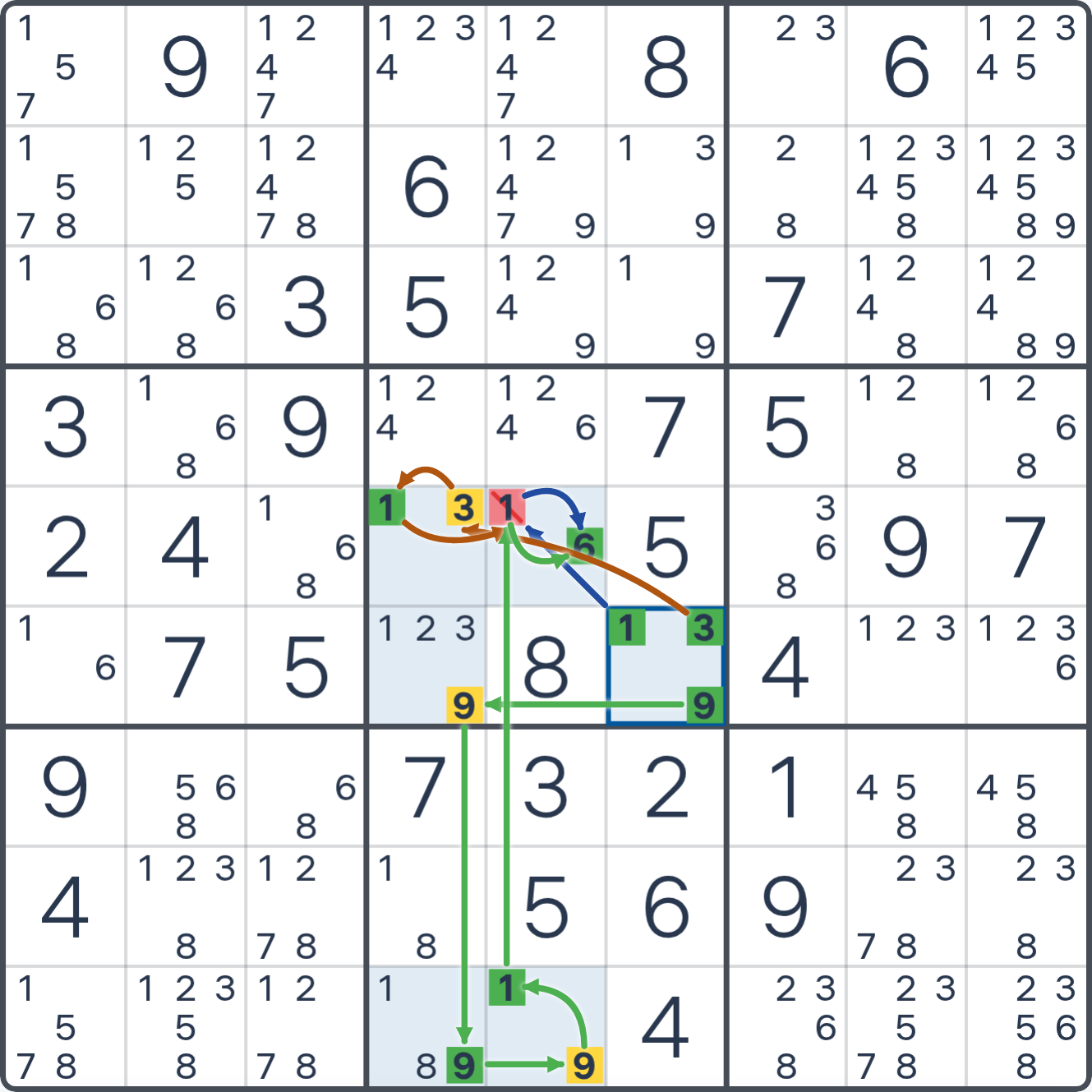
So value 1 can be removed from E5: all possible source positions force E5 to contain 6, so no other value can go there.
This walkthrough shows one valid example of the defined deduction. Confirm the stated source set or assumption, that every branch was tested, and that the applied conclusion is shared by all of them before using the same deduction on another grid. You can play sudoku online to practise with the current candidate state visible.
How to spot it
State the source proposition or exhaustive source set, then annotate every step with its reason. Compare all branches and accept only a target truth value shared by every one.
The logic
At least one source alternative is true. If each alternative implies the same target conclusion, the target conclusion holds regardless of which source is true. Optional branches must remain alternatives rather than being reported as forced links.